How to Apply for the Global Korea Scholarship (GKS)
The Global Korea Scholarship (GKS) is a Korean government scholarship program for international students who want to study at higher education institutions in South Korea. It is administered by the National Institute for International Education (NIIED).
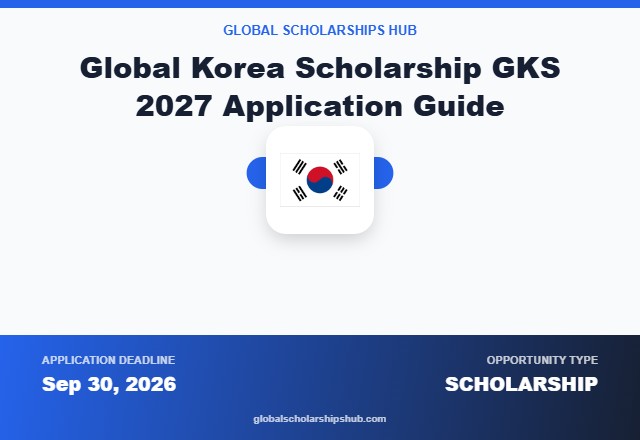
The application process is different depending on your study level and application track. For the 2027 undergraduate program (GKS-U), the official application guidelines have already been published. The Embassy Track application period is 15 September to 30 September 2026, while University Track deadlines are set by individual universities.
For graduate applicants, the latest official guideline currently available is for 2026 GKS-G. The 2027 GKS-G application guideline has not yet been published as of 22 September 2026.
Quick Details
| Detail | Current information |
|---|---|
| Scholarship | Global Korea Scholarship (GKS) |
| Country | South Korea 🇰🇷 |
| Provider | Korean Government / NIIED |
| Undergraduate program | GKS-U 2027 |
| Undergraduate levels | Associate Degree and Bachelor’s Degree |
| Graduate program | Master’s and Doctoral; 2027 call not yet published |
| Main application routes | Embassy Track and University Track |
| 2027 GKS-U Embassy Track | 15–30 September 2026 |
| Embassy Track deadline | 30 September 2026, 18:00 KST |
| University Track | September–November 2026; deadline varies by university |
| Undergraduate age | Under 25 |
| Academic requirement | At least 80%, top 20%, or accepted CGPA equivalent |
| Official application platform | Study in Korea |
| Official authority | NIIED |
🇩🇪 Germany Student Visa Guide 2027
Complete guide about visa requirements, documents, financial proof, and application steps for international students.
Read Guide →The 2027 GKS-U notice was officially published by Study in Korea on 9 September 2026, with revised application files dated 14 September 2026.
What Is the Global Korea Scholarship?
The Global Korea Scholarship is a government scholarship designed to bring international students to South Korea for higher education and international academic exchange.
The program includes different routes for undergraduate and graduate study. The official Study in Korea scholarship information lists Korean language training, degree study, tuition support, airfare and monthly allowances among the main scholarship benefits.
For 2027, the undergraduate program includes:
- Associate Degree programs
- Bachelor’s Degree programs
- Embassy Track
- University Track
- General and R-GKS options under the Embassy Track
- UIC and Associate Degree options under the University Track
The important point is that GKS is not one single application form for everyone. Your application method depends on your degree level, nationality, program and chosen track.
GKS Application Tracks
There are two main ways to apply for GKS.
1. Embassy Track
Under the Embassy Track, you apply through the Korean diplomatic mission responsible for your country.
For the 2027 GKS-U program, the Embassy Track application is submitted online through the Study in Korea system. The first-round selection is then handled by the relevant Korean embassy or designated selection office.
This route can allow eligible undergraduate applicants to select several universities according to the rules of their program and the official University Information file.
For 2027 GKS-U:
- General and Overseas Korean applicants may select up to three universities.
- At least one selected university must be Type B.
- R-GKS applicants may select up to two Type B universities.
2. University Track
Under the University Track, you apply directly to a participating Korean university.
There is no single deadline for every University Track applicant. Each participating university publishes its own application instructions and deadline within the GKS schedule.
For 2027 GKS-U, the University Track includes:
- UIC programs
- Associate Degree programs
You should therefore check the individual university’s GKS information before preparing your application.
Step 1: Check the Current GKS Call
Before preparing documents, first identify the correct GKS cycle.
This is especially important because GKS-U and GKS-G follow different schedules.
For undergraduate applicants
The 2027 GKS-U guidelines are officially available.
The Embassy Track application period is:
15 September 2026, 11:00 KST → 30 September 2026, 18:00 KST.
For Master’s and PhD applicants
The latest official graduate guideline currently available is 2026 GKS-G. NIIED published the 2026 graduate guidelines in February 2026.
As of 22 September 2026, the 2027 GKS-G guideline has not been published on the official GKS notice board.
Therefore, applicants should not use an unconfirmed 2027 graduate deadline as an official deadline.
Step 2: Check Your Eligibility
For 2027 GKS-U, applicants must satisfy the nationality, age, education and academic requirements in the official guideline.
Nationality
The applicant and both parents must generally hold non-Korean citizenship under the GKS-U nationality rules. Applicants with Korean citizenship or certain dual-nationality situations are subject to the restrictions in the official guideline.
Your country must also be eligible for the particular GKS track you want to use.
Age
For the 2027 undergraduate program, applicants must be under 25 years old.
The 2027 guideline uses 1 March 2002 as the relevant birth-date threshold.
Education
For a Bachelor’s Degree program, applicants generally must have:
- Completed high school; or
- Completed an Associate Degree; or
- Be expected to complete the required education by 31 December 2026.
For an Associate Degree program, applicants must have completed or be expected to complete high school by the required date.
Applicants who already hold a Bachelor’s Degree cannot apply for the GKS-U Bachelor’s program.
Academic Performance
For 2027 GKS-U, applicants need to satisfy at least one of the recognized academic conditions, such as:
- 80% or higher on a 100-point scale;
- Ranking within the top 20% of the class; or
- Meeting the required CGPA equivalent.
The published CGPA thresholds include:
| Grading scale | Minimum CGPA |
|---|---|
| 4.0 | 2.64 |
| 4.3 | 2.80 |
| 4.5 | 2.91 |
| 5.0 | 3.23 |
If your transcript uses a different grading system, check the current GKS instructions for the required conversion or supporting documentation.
Step 3: Choose the Correct Track
Do not start filling out the application before deciding whether you are applying through the Embassy Track or University Track.
Embassy Track is useful when:
- Your country has an Embassy Track allocation.
- You want to use the universities available under the Embassy Track.
- You want to apply according to the embassy selection process.
University Track is different because:
- You apply directly to the participating university.
- You must follow that university’s deadline.
- Available programs are limited to the universities and departments listed for the relevant GKS program.
The official University Information files should always be checked before selecting a university or department.
Step 4: Research Universities and Departments
This is one of the most important parts of the application.
Do not choose a university simply because it is famous.
Instead, check:
- Whether the university participates in your GKS track
- Whether your intended major is available
- Whether the department accepts GKS applicants
- Language requirements
- Required additional documents
- Type A or Type B status where relevant
- Location
- Program structure
- University-specific requirements
NIIED provides separate University Information files with the 2027 GKS-U announcement. These files should be checked together with the main application guidelines.
For Embassy Track applicants, university selection rules are important. For example, General applicants may select up to three universities, with at least one Type B university under the 2027 rules.
Step 5: Prepare the GKS Application Documents
The 2027 GKS-U application package includes several forms and supporting certificates.
The main application forms include:
- Application Form
- Personal Statement
- Study Plan
- Recommendation Letter
- GKS Applicant Agreement
- Personal Medical Assessment
- Consent to Collect and Use Personal Information
Applicants also need relevant academic and identity documents, which can include:
- High school graduation certificate or expected graduation certificate
- Academic transcript
- Proof of the applicant’s citizenship
- Proof of parents’ citizenship
- Proof of family relationship
- Associate Degree documents, where applicable
- Other documents required by the program
- Optional language certificates or achievement documents where applicable
The exact document list and authentication rules should be taken from the current GKS guideline rather than an older checklist.
Do not leave document authentication until the last week
Some certificates may need apostille or consular confirmation, depending on where they were issued and the stage of the selection process.
Documents that are not in English or Korean may also require an appropriate translation according to the current guidelines.
Because authentication and certified translation can take time, start this process early.
Step 6: Write a Strong Personal Statement
The Personal Statement is your opportunity to explain your background and academic development.
Do not simply write:
“I want to study in Korea because Korea is a developed country.”
A stronger statement explains your own academic journey.
You can discuss:
- Your educational background
- Important academic experiences
- Activities or achievements
- Your interest in the chosen field
- Problems or questions that motivated your studies
- Why the selected field is important to your future
Keep the information truthful.
Do not copy another applicant’s statement or use a generic statement that could belong to any student.
Step 7: Prepare a Clear Study Plan
Your Study Plan should connect your academic interests with your proposed study in Korea.
A useful structure can include:
Academic goals
Explain what you want to learn.
Study interests
Explain the subjects, skills or areas you want to develop.
University fit
Explain why the selected program matches your academic interests.
Future plans
Explain how the education will support your longer-term academic or professional goals.
Your Personal Statement and Study Plan should support the same academic story.
For example, if you say that your main interest is environmental engineering but your Study Plan focuses entirely on business without explanation, the application may appear inconsistent.
Step 8: Get Your Recommendation Letter
The 2027 GKS-U application requires a recommendation letter.
Ask a suitable recommender early rather than waiting until the application deadline.
The recommender should be someone who knows your academic ability and can provide meaningful information about your potential.
Give the recommender enough time to:
- Review your background
- Understand your intended major
- Write the recommendation
- Sign the required document
- Return it in the required format
For Embassy Track applicants, the recommendation letter is handled through the application process, while applicants who pass the first round may need to provide original documents for the next stage.
Step 9: Submit the Embassy Track Application Online
For the 2027 GKS-U Embassy Track, the official online application period is:
15 September 2026 at 11:00 KST to 30 September 2026 at 18:00 KST.
Applicants must register on the Study in Korea system and complete the required information and document uploads.
Do not wait until the final hour.
Before submitting, check:
- Name spelling
- Date of birth
- Citizenship
- Education information
- Grades
- University choices
- Major
- Recommendation information
- Uploaded documents
- Signatures
- Required certificates
- File quality
After submission, keep evidence of the completed application according to the system instructions.
Step 10: Follow the University Track Instructions if Applying Directly
University Track applicants do not simply submit the Embassy Track application.
You must identify an eligible participating university and follow its specific GKS instructions.
The university may specify:
- Application method
- Email or online submission
- Required documents
- Interview procedure
- Application deadline
- Additional university documents
For example, KOREATECH has published a separate 2027 GKS-U University Track schedule and instructs applicants to follow its university-specific process.
Therefore, always check the university’s official GKS notice.
Step 11: Understand the Selection Process
The selection normally involves more than one stage.
For the Embassy Track, the general process is:
Application → First-round selection → NIIED review → University selection → Final result
For the University Track, the process begins with the participating university and then proceeds according to the GKS selection system.
The exact schedule can vary by program and institution.
Passing the first round does not automatically mean that you are the final GKS scholar.
What Does GKS Cover?
GKS provides substantial financial support, but applicants should understand exactly what each benefit means.
The official Study in Korea GKS information lists:
- Airfare
- Korean language training
- Tuition
- Monthly allowances
For the 2027 GKS-U cycle, published guideline summaries report:
- Korean language training support
- Tuition support
- Economy-class airfare under the program rules
- Annual living support of KRW 13.56 million during the language year
- Annual living support of KRW 14.4 million during the degree period
These annual figures correspond to approximately KRW 1.13 million and KRW 1.2 million per month respectively.
NIIED also states that the scholarship benefit structure and amounts are determined by the applicable year’s guideline. Therefore, applicants should always use the current official guideline rather than older GKS benefit tables.
Is GKS fully funded?
GKS is commonly described as a fully funded government scholarship because it provides major study-related financial support.
However, applicants should not interpret this as meaning that every personal expense is automatically paid.
For example, accommodation and other living costs may need to be managed from the applicable allowance rather than treated as a separate unlimited housing payment.
This distinction is important when planning your budget.
Do You Need IELTS or TOEFL for GKS?
There is no single universal statement that every GKS applicant must submit IELTS or TOEFL.
The requirement can depend on the program, university, department and application circumstances.
For the general GKS-U application, applicants should follow the current GKS guideline and the University Information file. Some universities or departments may have additional language requirements.
For example, KOREATECH’s 2027 GKS-UIC information specifies English-language requirements for its English-track program.
Therefore:
Do not claim that GKS is “No IELTS” for every applicant.
Instead, check the specific university and department.
Do You Need Korean Language?
You do not generally need to already speak Korean simply to start preparing a GKS-U application.
The GKS-U structure includes Korean language training before the degree for applicable scholars.
The official Study in Korea information describes the undergraduate structure as:
1 year of Korean language training + 2–3 years for an Associate Degree or 4–6 years for a Bachelor’s Degree.
Some applicants may qualify for language-related exemptions under the official rules, so check the current guideline if you already have a recognized Korean-language qualification.
GKS 2027 for Afghan Applicants
Afghanistan is included in the 2027 GKS-U Embassy Track allocation.
The published 2027 allocation gives Afghanistan:
- 1 General place
- 1 R-GKS place
- 2 Embassy Track undergraduate places in total
The Korean Embassy responsible for Afghanistan has also published a 2027 GKS-U notice, listed in its official notice archive.
Afghan applicants should therefore follow the current Korean Embassy notice for Afghanistan together with the NIIED guideline.
Do not rely only on information from scholarship blogs or social media because embassy-specific instructions can affect the first-round process.
What About GKS for Master’s and PhD?
GKS also supports graduate study.
The graduate program includes:
- Master’s Degree
- Doctoral Degree
- Certain research and specialized programs depending on the cycle
The latest official graduate guideline currently available is 2026 GKS-G, which planned to invite 2,000 international graduate students. Applicants could apply through either the Embassy Track or University Track.
However, the 2027 GKS-G guideline has not yet been officially published as of 22 September 2026.
Therefore, if you are looking for a Master’s or PhD scholarship for 2027, use the 2026 information only for preparation and do not treat its deadline, quota or funding figures as confirmed 2027 requirements.
Common GKS Application Mistakes
1. Using an old application form
GKS rules and forms can change every year.
Use the forms published with the current cycle.
2. Choosing universities without checking the University Information file
A university may be available in one GKS route but not another.
Always check the current file.
3. Ignoring Type A and Type B rules
This can be particularly important for Embassy Track applicants.
Check the university-selection rules before submitting.
4. Waiting too long for document authentication
Apostille, consular confirmation and certified translations can take time.
Start early.
5. Writing a generic Personal Statement
Your statement should explain your actual academic background and goals.
6. Submitting inconsistent information
Your application form, transcript, Personal Statement, Study Plan and recommendation should not contradict each other.
7. Assuming IELTS is never required
Language requirements can vary by university and department.
8. Assuming every expense is separately covered
Understand the difference between tuition, airfare, monthly allowance and other benefits.
9. Applying through the wrong route
Embassy Track and University Track have different procedures.
10. Waiting until the deadline day
Technical problems, document problems or slow uploads can cause unnecessary risk.
Submit before the final hours whenever possible.
Frequently Asked Questions
When is the GKS 2027 application deadline?
For the 2027 GKS-U Embassy Track, applications close on 30 September 2026 at 18:00 KST. University Track deadlines vary by university.
Where do I apply for GKS?
Embassy Track undergraduate applicants use the Study in Korea online application system. University Track applicants apply directly according to the instructions of the participating university.
Can I apply for GKS without IELTS?
Do not assume that IELTS is universally required or universally waived. Check the current GKS guideline and the specific university or department requirements.
Is GKS available for Bachelor’s students?
Yes. The 2027 GKS-U program includes Bachelor’s Degree programs and Associate Degree programs.
Is GKS available for Master’s and PhD students?
Yes. GKS has graduate programs for Master’s and Doctoral study. However, the 2027 GKS-G guideline has not yet been published as of 22 September 2026. The latest official graduate guideline available is for 2026.
Can Afghan students apply for GKS?
Yes. Afghanistan is included in the 2027 GKS-U Embassy Track allocation, with one General place and one R-GKS place. Afghan applicants should follow the current Korean Embassy notice and the NIIED guidelines.
How many universities can I choose?
For the 2027 GKS-U Embassy Track, General and Overseas Korean applicants can select up to three universities, including at least one Type B university. R-GKS applicants can select up to two Type B universities.
Does GKS pay tuition?
Tuition is one of the benefits listed under the GKS program. The exact payment structure and limits should be checked in the guideline for the specific application year.
Is accommodation free under GKS?
Do not assume that a separate free dormitory is automatically provided. Current GKS-U benefit information indicates that accommodation-related costs are managed through the scholarship allowance rather than treated as unlimited separate housing support.
What should I do first?
First, open the official GKS announcement for your study level and year. Then check eligibility, download the current guideline and University Information file, and identify the correct application track.
Other Best Scholarships
university-padua-regional-scholarship
Sunhak Peace Prize Internship in South Korea – Details
SGAC × Silicon Valley Space Week 2026 Scholarship in USA
Global Korea Scholarship (GKS) 2026 Study in Korea
Japan-Afghanistan Language School Pathways Scholarship in Japan

Open Doors Russia Scholarship 2027
Want to apply for the Open Doors Russia Scholarship? Get professional guidance and registration support from our team.
🟢 Chat With Us on WhatsApp
Get in touch today for registration assistance.
Useful Scholarship Guides
Helpful guides for your scholarship application
Study Opportunities by Country
Explore scholarships and study opportunities in popular countries.